ARTICLE SENDING AND COPYRIGHT TRANSFER FORM
EVALUATION PROCESS
Applications for articles requested to be published in AYDIN GASTRONOMY shouldbe madethrough DergiPark(https://dergipark.org.tr/tr/pub/aydingas).
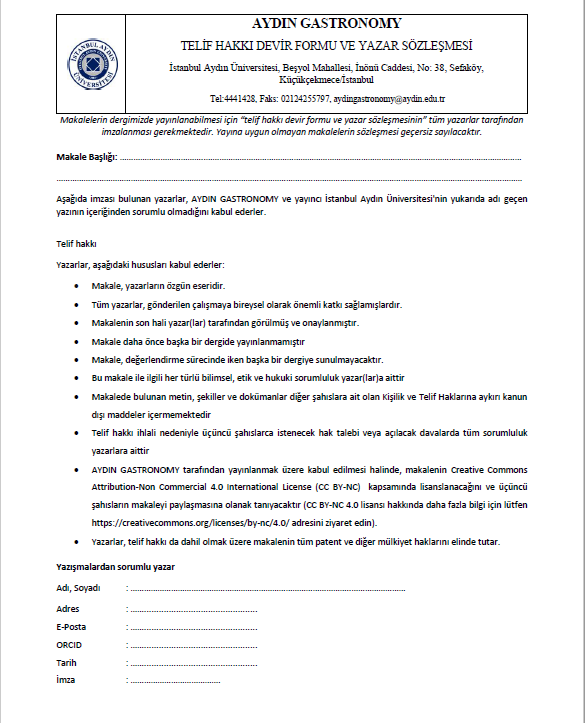
Authors must complete the "copyright transfer form" for the publication during the application and submit it to the journal editorial office with a wet signature. Wet signed forms must be uploaded as PDF via DergiPark.
Articles that "require the permission of the Ethics Committee" are specified in the TR Index criteria. In such articles, reference should be made in the method section (especially under the heading of "Data Collection" or "Data Collection Tools" as in the relevant example below.
Example: ……………….for……………………… University Rectorate……………………….. From the Ethics Committee ../..Necessary permission was obtained with the decision dated…/…. and numbered….
In addition to this statement, the official letter "Ethics Committee decision" or equivalent is expected to be uploaded with the article. For research articles produced from studies that do not require an Ethics Committee decision, the "Declaration Form on No Need for Ethics Committee Permission" should be filled. These documents should be uploaded as PDF via DergiPark.
All articles sent to AYDIN GASTRONOMY are scanned with software programs such as Turnitin, iThenticate, etc. immediately after the application. Studies with a similarity of more than 20% and more than 5% from a single source in the entire study as a result of the screening are not included in the preliminary evaluation. Studies with a similarity rate below 20% are checked in terms of whether the source is given at the end of each sentence cited; whether the quote is from the main source (in some cases, the main source is cited instead of quoting from a different source). If there is a block quotation in the study, if the similar sections are not cited, or if the similarity belongs to a source other than the main source and there is no transferring expression, the study is not taken into consideration.
The journal editor primarily evaluates an article submitted to AYDIN GASTRONOMY. Studies that do not coincide with the purpose and scope of the journal, are weak in terms of academic publication language and Turkish (English) grammar and expression rules, contain scientifically unacceptable errors, have no original value and do not coincide with the publication principles are rejected directly by the editor. If it is decided to reject the manuscript during the initial submission process, the reason for this is clearly and impartially stated to the authors. In this process, if it is decided that the article should be revised in terms of grammar, punctuation and/or spelling rules (margins, referencing appropriately, etc.), the authors are informed about this and given time to make the necessary corrections.
The referee evaluation process is initiated for the works deemed appropriate to be sent to the referees by the editor. At this stage, the editor directs at least two referees to evaluate the relevant work, taking into account its content. The editor can determine the referee from the AYDIN GASTRONOMY referee pool or appoint a new referee suitable for the field of the study. In the evaluation of the articles, the double-blind refereeing process is carried out and the author and referee identities are hidden.
Referees make the necessary review of the articles sent to them within the defined time period. They complete their evaluation of the article by filling out the referee evaluation form through the DergiPark system. If the referees do not evaluate the work within a reasonable time, additional time is given. If the evaluation is not completed within this period, the study is sent to different referees. Each reviewer makes a decision about the article as "may be published (accepted) ", "may be published after correction" or "may not be published (rejected)". He/she is expected to write a detailed justification of both acceptance and rejection decisions and, if any, suggestions for correction in his/her report.
The editor may ask the author(s) to make corrections in their publications in line with the opinions of the referees evaluating the publication. The author(s) may object to the referees' evaluation opinions provided that they provide explanatory evidence. The objections made are evaluated by the Editorial Board and if deemed necessary, a different referee's opinion can be applied for the publication sent. Authors also have the right to withdraw their publications at this stage. When there are two different opinions about the article in positive and negative terms, the opinion of a third referee is also requested. The final decision on the article to be published is made by the editor. If the decision is negative, the reason for REJECTION is sent to the author with an explanation together with the referee reports. If it is positive, the volume and number of the article to be published are notified to the author.